Expert NFL Betting Tips UK
 Available in US
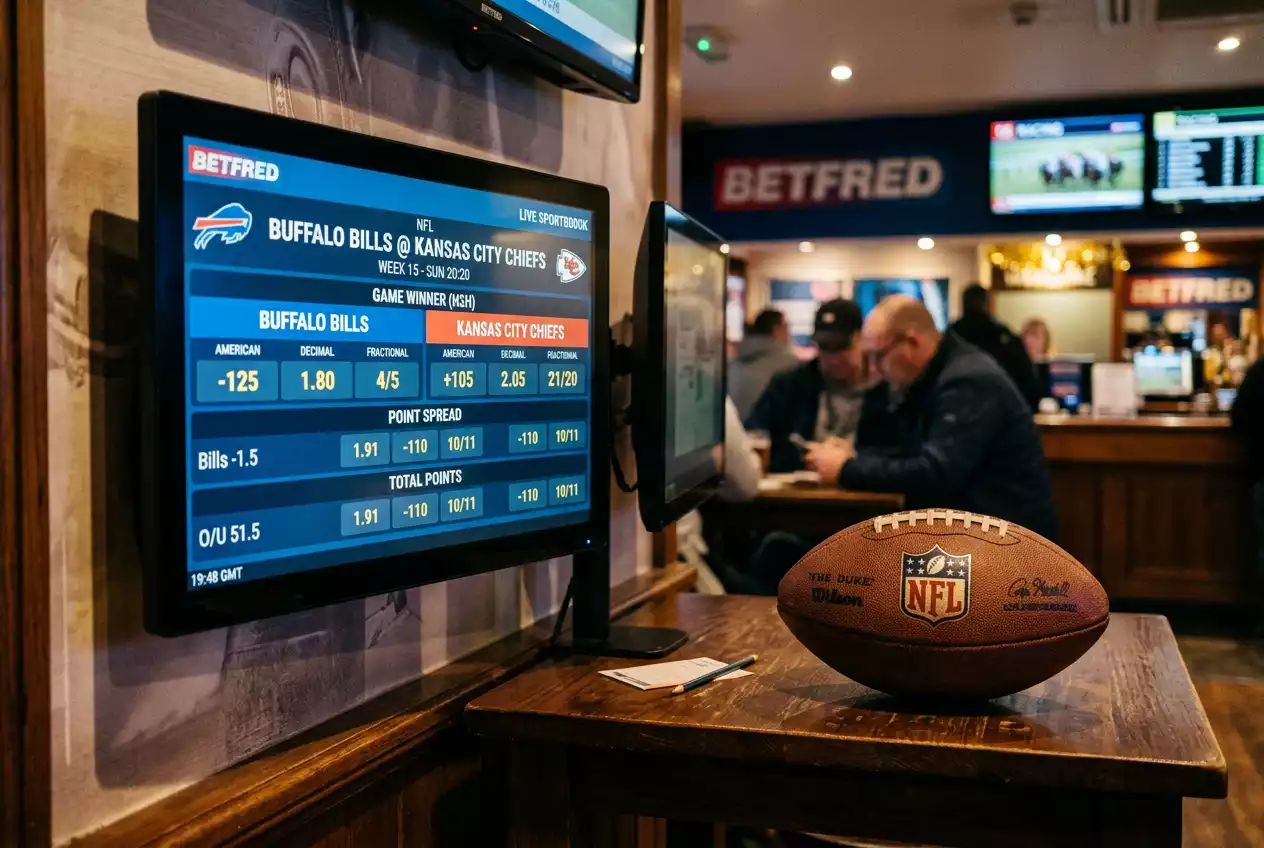
Three seasons ago I tracked every NFL bet I placed over an entire 18-week regular season. Wins and losses, odds taken, closing line value, and the reasoning behind each selection. At the end, the data was brutal: my bets based on “gut feel” and team narratives had a negative ROI of -6.2%. My bets based on quantifiable edges — ATS trends, line movement, and public percentage data — returned +3.8%. Same bettor, same bankroll, same season. The only difference was the decision-making framework. A great way to find value when the spread looks too tight is to analyze the NFL over/under totals for potential scoring trends.
NFL betting tips, in the way most people think about them — “take the Chiefs -3.5 this week” — are largely worthless. A specific pick without the methodology behind it teaches you nothing and expires in three hours. What actually moves the needle is understanding the systems that identify value: where the market is mispriced, why it’s mispriced, and how to act before the price corrects. NFL betting through Entain platforms in the UK surged 65% year on year during the 2024-25 season, which means more British punters are entering this market than ever. Most of them are betting on instinct. This piece is about replacing instinct with process.
Identifying Value in NFL Betting Markets
Every bet you place has an implied probability embedded in the odds. Decimal odds of 1.91 imply a 52.4% chance. Decimal odds of 2.50 imply 40%. Value exists when your estimated probability of an outcome is higher than the probability implied by the odds. If you believe a team has a 55% chance of covering the spread, and the odds imply only 52.4%, that’s a value bet — regardless of whether it wins or loses on the day.
This distinction between a value bet and a winning bet is the hardest concept in sports betting, and it’s the one that separates recreational punters from those who sustain profitability. A value bet can lose. A non-value bet can win. But over hundreds of bets, consistently taking positive expected value produces profit, and consistently ignoring it produces loss. The maths is unforgiving: the UK sees approximately 290 million online sports bets placed per month, and the bookmakers’ collective GGY proves that most of those bets are placed at negative expected value.
How do you estimate true probabilities? Not by watching one game and forming an opinion. You need inputs that the market might be mispricing — and in the NFL, three data categories consistently produce actionable value: against-the-spread records, public betting percentages, and line movement patterns. Each of these tells you something different about where the market’s consensus might be wrong.
Let me put this in concrete terms. Suppose a game is priced at -3 for the favourite at odds of 1.91 — implying roughly 52.4% probability that the favourite covers. Your analysis of ATS records, public money flow, and line movement suggests the underdog covers at 56% probability. The true fair odds for the underdog should be around 1.79, but you’re getting 1.91. That gap between the bookmaker’s implied probability and your estimated probability is the value. Over one bet, it might not show. Over 200 bets across a season, those 3-4 percentage point edges compound into measurable profit.
Value betting isn’t about being smarter than the bookmaker on every game. It’s about identifying the three or four games per week where your analysis suggests the market has drifted from fair value — then sizing your bets appropriately and letting the law of large numbers work over the season. I pass on more games than I bet. That’s not timidity; it’s discipline. A week where I place zero bets because nothing meets my value threshold is a successful week, not a boring one.
The rest of this article breaks down each of those three data categories — ATS trends, public percentages, and line movement — and shows how to combine them into a weekly research process that consistently surfaces value. None of these tools works perfectly in isolation. The edge comes from triangulation.
ATS Trends Analysis
I nearly stopped tracking ATS records after my first season because the data seemed noisy. A team would go 5-1 ATS and I’d back them confidently — only to watch them go 1-4 ATS over the next five games. It took a full year of deeper analysis before I understood what ATS records actually tell you, and more importantly, what they don’t.
ATS stands for “against the spread.” A team’s ATS record shows how often they’ve beaten the point spread, not how often they’ve won games outright. A 3-7 team that has covered the spread in 8 of 10 games is an ATS powerhouse, because the market has consistently underestimated them. Conversely, a 9-1 team that has covered only 4 of 10 spreads is overvalued by the market — they win, but not by enough to beat the inflated number.
During the 2025 NFL season, favourites won outright 65.9% of the time but covered the spread in just 47.8% of games. That discrepancy is the ATS gap, and it persists year after year. The public overvalues winning teams and undervalues losing teams, which inflates the spread on favourites and deflates it on underdogs. The result is that underdogs cover at a rate above 50% in most seasons — not dramatically above, but consistently enough to create a structural edge for bettors willing to take the less popular side.
The useful ATS trends go beyond overall record. Home ATS versus away ATS tells you whether a team outperforms expectations in a specific environment. Divisional ATS reveals whether a team plays to form in rivalry games (many don’t — divisional games are famously close regardless of talent gap). ATS as a favourite versus ATS as an underdog isolates whether the team’s spread performance changes based on public perception. And ATS in the second half of the season versus the first half can surface teams whose true quality is diverging from their early-season reputation.
But — and this is the crucial caveat — ATS records alone are not a betting system. They’re a diagnostic tool. A team going 8-2 ATS might be genuinely undervalued, or they might have been lucky: three of those covers came by a single point in games that could have gone either way. Small sample sizes make ATS records volatile. Over a 17-game regular season, a team’s ATS record is influenced by randomness far more than most bettors acknowledge. I use ATS as a filter, not a decision. If a team has a strong ATS record and my other indicators (line movement, public percentages) align, that convergence strengthens the case. If the ATS record is strong but everything else contradicts it, I pass.
Where ATS analysis becomes genuinely powerful is in situational subsets. Teams coming off a bye week ATS, teams in primetime ATS, teams following a blowout loss ATS — these subsets isolate specific circumstances where market pricing might lag reality. A team returning from a bye has had two weeks to prepare and heal injuries; the spread often doesn’t fully account for that advantage. Similarly, teams that just suffered an embarrassing defeat frequently bounce back to cover the following week as the market overreacts to the loss. These situational edges are small — one or two percentage points — but compounded over a season, they matter.
Public Betting Percentages
Roughly 10% of the UK population bets on sports online. Within that group, the vast majority are recreational bettors — people who place a few pounds on the team they think will win, influenced by media coverage, recent results, and brand familiarity. When 75% of the public puts their money on one side of a spread, that tells you something about perception. It doesn’t tell you anything about probability.
Public betting percentages track the share of total bets (and sometimes total money) on each side of a market. These figures aren’t published by UK bookmakers directly, but several free and subscription-based services aggregate data from US sportsbooks and offshore markets to produce consensus numbers. While the data isn’t UK-specific, the NFL is a global market — lines set in the US propagate to UK sportsbooks within minutes — so US-based public percentages are a reasonable proxy for the overall betting population’s behaviour.
The contrarian principle is simple: when the public overwhelmingly backs one side, the other side tends to offer value. Not always, and not mechanically — you can’t just fade every popular pick and expect to profit. But when public percentage data shows 70%+ of bets on a favourite, and the line hasn’t moved in the favourite’s direction (or has actually moved toward the underdog), that’s a signal worth investigating. It suggests that the sharp money — the informed, high-volume bettors whose action actually moves lines — is on the opposite side of the public.
I use public percentages as a second filter, layered on top of ATS analysis. If a team has a strong ATS record as an underdog and the public is heavily backing the opponent, both filters point in the same direction. That convergence doesn’t guarantee a win, but it means two independent data sources are telling the same story. When three or more independent signals align — ATS, public percentages, and line movement — I increase my confidence and sometimes increase my stake size within my predetermined limits.
The threshold matters. A 55-45 public split is noise — it’s too close to 50/50 to carry meaning. A 70-30 split is signal. A 80-20 split is a strong signal, especially in a non-marquee game where the public’s opinion is more likely based on name recognition than analysis. The most profitable contrarian spots in my experience are underdog sides in early-window Sunday games where the public is overwhelmingly backing a well-known favourite against a small-market team. The casual bettor instinctively backs the name they recognise — and casual bettors move the percentage without moving the line.
A common mistake is treating public percentage data as a standalone system. “Just fade the public” sounds like a strategy, but applied blindly it produces mediocre results. The public is often right — that’s why lines exist in the first place. The edge comes when public percentages diverge from the other signals in your toolkit. If the public is 75% on Team A, Team B has a strong ATS record as an underdog, and the line has moved toward Team B despite the public weight — that triple convergence is where real value lives. Public percentages alone identify potential value spots; combined with ATS and line movement data, they confirm them.
Line Movement Signals
Lines move for a reason. Understanding that reason is the third pillar of NFL value identification, and in some ways it’s the most directly actionable. ATS records look backward, public percentages describe sentiment, but line movement tells you what’s happening right now — in real time, in real money.
NFL spreads open on Sunday evening for the following week’s games. Between that opening and kickoff six or seven days later, the line might move two or three points. The key question is: who moved it? If the line shifts because 80% of individual bets are on the favourite, that’s public money — the combined weight of thousands of small wagers. If the line shifts despite even bet counts, that’s sharp money — a smaller number of large, informed wagers from professional bettors. In-play betting, as Technavio’s UK market analysis noted, has transformed betting patterns through high-frequency wagering during live events, with real-time odds generation improving engagement by 25%. That same real-time dynamic applies to pre-match line movement: the speed and direction of shifts carry information.
Reverse line movement is the most powerful signal. This occurs when the public heavily backs one side but the line moves in the opposite direction. If 75% of bets are on the Chiefs -3, but the line drops to Chiefs -2.5, something unusual is happening. The bookmaker isn’t moving the line to balance recreational bets — they’re responding to sharp action on the other side. Professional bettors have placed enough money on the opponent to outweigh the public’s volume. That’s a meaningful data point, because sharp bettors have a documented long-term edge over the market.
Steam moves are a related concept: rapid, simultaneous line shifts across multiple sportsbooks. When the same spread moves from -3 to -3.5 at five different operators within minutes, it typically means a syndicate or a respected sharp bettor has placed significant action. Steam moves are hard to catch in real time unless you’re monitoring odds feeds, but tracking where the line opened versus where it closes gives you the same information retrospectively — and helps calibrate your own assessments for future weeks.
For UK bettors, the practical application is this: check the opening line on Sunday night, note the current line on Thursday or Friday, and compare. If the spread has moved half a point or more and the public percentage data doesn’t explain the movement, sharp money is likely responsible. Align that with your ATS analysis and you have a triangulated view of the game’s betting landscape.
One caveat: not all line movement is meaningful. A line moving from -6 to -6.5 might just reflect a normal accumulation of recreational bets. The movements that carry the most signal are those that cross key numbers (3, 7, 10) or move against heavy public action. A shift from -3 to -2.5 when the public is on the favourite is worth ten times more attention than a shift from -5.5 to -6 with even betting splits. Context determines whether a line move is noise or signal.
Your Weekly Research Routine
Theory without routine is entertainment. I’ve refined my weekly NFL research process over six seasons, and while the specifics evolve as new data sources emerge, the structure stays constant. Here’s what a typical week looks like.
Sunday night after the games: opening lines release. I scan the board, note any spreads that look off based on my immediate reaction, and log them. This takes ten minutes. I don’t bet on Sunday night — the lines are at their thinnest and most volatile. The purpose is to anchor my expectations for the week.
Monday and Tuesday: injury reports begin to surface. I cross-reference injuries with the games I flagged on Sunday night. A starting quarterback being listed as questionable changes the calculus entirely. I also review the previous week’s ATS results and update my running ATS database. Teams that covered in surprising fashion go on a watchlist; teams that failed to cover as heavy favourites get a second look the following week.
Wednesday: public betting percentages start to stabilise. Enough recreational action has flowed to give the consensus numbers meaning. I compare the current line to the opener and note any movement. If a line has moved a full point and the public is on the opposite side, that’s a reverse line movement flag. I build a shortlist of two to four games where ATS, public percentages, and line movement converge.
Thursday: I research my shortlisted games in detail — matchup analysis, weather forecasts, situational factors (bye weeks, short rest, cross-country travel). This is the analytical deep dive, and it takes one to two hours. I convert each analysis into a simple question: does this game meet my value threshold at the current price? If yes, I bet. If no, I remove it from the shortlist.
Friday to Sunday morning: I monitor for late-breaking news — injury downgrades, unexpected inactives, sharp money arriving late. If new information changes the picture, I adjust. If it doesn’t, my bets are already placed and I watch the games without needing to make impulsive decisions. The goal is to have all analytical work done by Thursday night, so that Sunday is about execution, not deliberation.
This routine might sound rigid, but that’s the point. Emotional betting happens when you improvise. Process-driven betting happens when you follow a structure that separates analysis from execution. The specific tools I use — ATS databases, public percentage trackers, odds comparison sites — are freely available. The edge isn’t in the tools. It’s in the discipline to use them consistently, week after week, whether you’re betting pre-match or live. We provide reliable NFL betting analysis to help British punters make smarter, data-driven decisions every week.
One final observation from ten years of doing this: the routine itself becomes a competitive advantage over time. By Week 8, you’ve accumulated seven weeks of personal data — which games you bet, which you passed on, which your filters flagged correctly and which they missed. That feedback loop lets you calibrate. Maybe your contrarian threshold should be 72% instead of 70%. Maybe your ATS filter performs better on away underdogs than home underdogs. Maybe you consistently overvalue late-season line movement. The weekly routine generates the data; the seasonal review extracts the lessons. Both are essential, and neither works without the other.
How do I read ATS records to evaluate NFL teams for betting?
ATS stands for ‘against the spread.’ A team’s ATS record shows how often their results have beaten the point spread set by bookmakers, not simply how often they have won. A team with a 4-6 win-loss record but a 7-3 ATS record is consistently outperforming market expectations. Look at ATS splits by home/away, as favourite/underdog, and in situational subsets like after bye weeks or in divisional games for more granular insights.
What percentage of NFL public bets should trigger a contrarian play?
A public betting percentage above 70% on one side — particularly on a favourite in a non-marquee game — is generally considered a meaningful signal. Below 65%, the split is too close to carry contrarian weight. The signal strengthens when the public is overwhelmingly on one side but the line has moved in the opposite direction, suggesting sharp money disagrees with the consensus.
How far in advance do NFL lines move before kickoff?
NFL spreads typically open on Sunday evening for the following week’s games and move throughout the week. The most significant movements occur in two windows: Monday to Wednesday as sharp bettors act on their early analysis, and Sunday morning as late-breaking injury news and final sharp action arrive. A total movement of 1 to 2 points from open to close is common; movements of 3 or more points indicate a major information shift such as a starting quarterback being ruled out.
Published by the nfl Betting Fourm team.