Profitable NFL Betting Strategy
 Available in US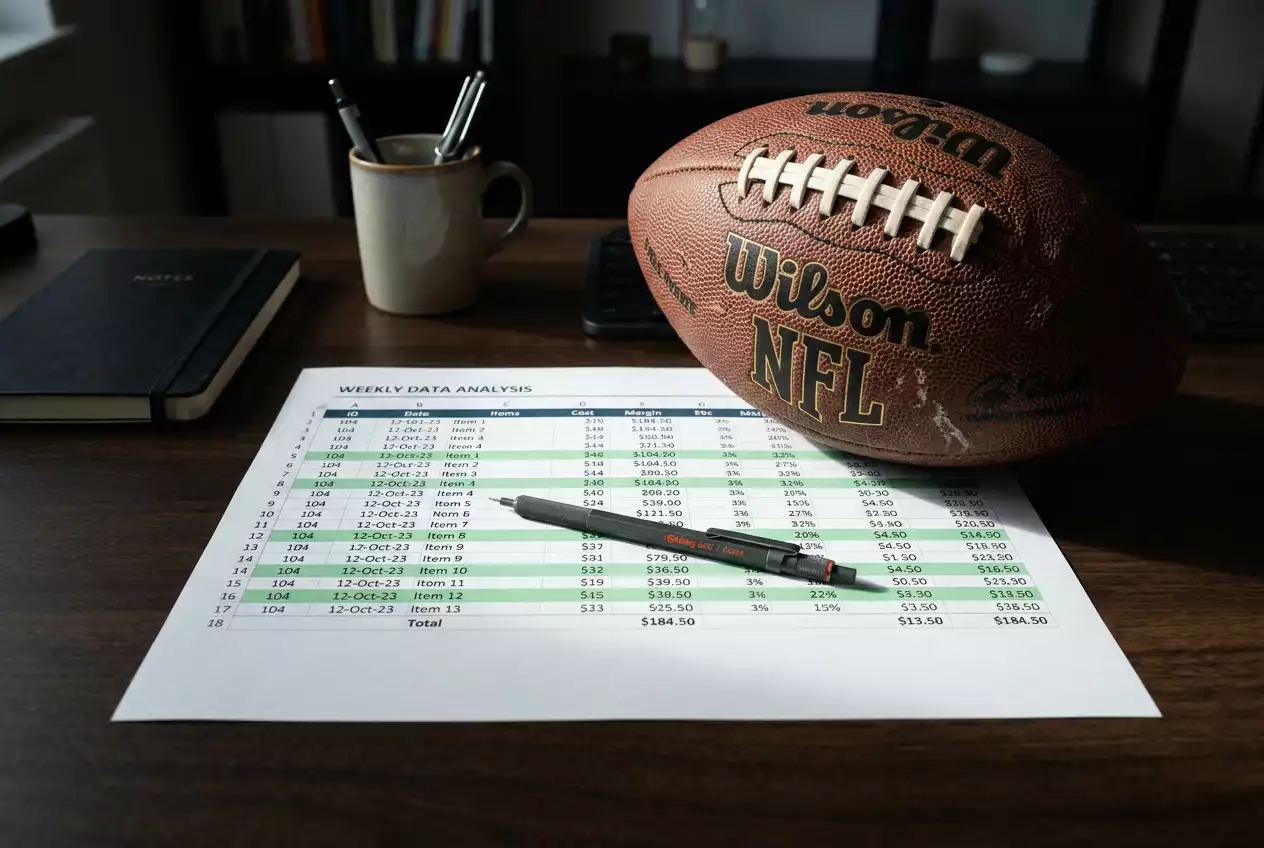
The UK’s online sports betting market has grown from roughly $2.29 billion in 2017 to $4.21 billion in 2023, with projections pointing toward $5.69 billion by 2029. That growth brings new money into every sport on the board — and the NFL, once a niche curiosity for British punters, is absorbing a rising share of it. More money in the market means more competition, thinner edges, and a higher premium on strategy. Winging it worked in 2018. It doesn’t work in 2026.
I’ve spent the better part of a decade building, testing, and refining NFL betting strategies from the UK. Some of those strategies were profitable. Others were expensive lessons. The constant across every approach that’s survived is structure: a defined bankroll, consistent unit sizing, deliberate market selection, and rigorous tracking. The flashy part of NFL betting — picking winners, reading spreads, identifying value — gets all the attention. But the structural part — how you manage your money, which bets you skip, how you evaluate your own performance — is what determines whether you’re still solvent in February.
This isn’t a beginner’s guide. If you need to understand what a spread is or how odds work, start there first. This is a systematic framework for approaching the NFL season as a long-term project rather than a series of isolated wagers.
NFL Bankroll Management and Unit Sizing
The first NFL betting conversation I had that actually changed my approach wasn’t about football at all. It was with a poker player who asked me one question: “Can you lose your entire bankroll and still pay your rent?” I couldn’t answer yes, because at that point my “bankroll” was whatever happened to be in my betting accounts — mixed in with money I needed for bills. That’s not a bankroll. That’s a disaster waiting to happen.
A bankroll is a discrete sum of money, separated from your living expenses, that you can afford to lose entirely without it affecting your life. That definition isn’t negotiable. Among online sports bettors in the UK, 8.7% score at the problem gambling threshold on the PGSI scale — more than double the 4.2% rate across all gambling types. The single most important factor separating recreational betting from problem gambling is whether your stake money is ringfenced from essential spending. If losing your NFL bankroll would cause you to miss a payment, reduce your food budget, or create financial stress, the bankroll is too large. Cut it in half and start there.
How large should the bankroll be? There’s no universal answer, but I think in terms of units. A unit is your standard bet size, and your bankroll should contain enough units to absorb a realistic losing streak without going bust. For NFL spread betting at close to even money, a losing streak of 8 to 12 bets is not uncommon during a season — it’s a statistical certainty if you bet frequently enough. A bankroll of 50 units means a 12-bet losing streak costs 24% of your bankroll. Painful, but survivable. A bankroll of 20 units means the same streak costs 60%. That’s a recovery scenario, not a strategy.
I recommend a minimum of 50 units for any bettor placing 3 to 5 NFL bets per week. That gives you enough cushion to weather variance without adjusting your approach mid-season. If you’re more conservative — 1 to 2 bets per week — 30 units can work, because your total exposure per week is lower and the probability of a catastrophic losing streak within any given month is smaller.
The wider context matters here too. The overall problem gambling rate in the UK sits at 2.7% based on PGSI scores of 8 or higher, stable year on year. Among men, that figure is 6%, and among 18-to-24-year-olds it reaches roughly 10%. If you’re in a higher-risk demographic, be honest with yourself about bankroll sizing. The discipline to set a bankroll limit is identical to the discipline that makes you a better bettor — both require you to override impulse with structure. As Gambling Commission chief executive Andrew Rhodes has stressed, understanding gambling behaviour and its consequences is a critical part of the evidence base that supports the entire industry’s regulatory framework.
Once your bankroll is set, fund it and leave it alone. Don’t top it up after a losing week. Don’t withdraw after a winning week. Let the bankroll grow or shrink according to your results over a meaningful sample — at least one full NFL season. If it grows, your strategy has a positive edge and you can consider increasing your unit size for the following season. If it shrinks, your strategy needs adjustment, and topping up the bankroll just delays the reckoning.
Unit Sizing Methods
A unit is not a fixed pound amount — it’s a percentage of your bankroll. That distinction matters more than it sounds. If your bankroll is £500 and your unit is 2%, each bet is £10. If your bankroll grows to £600 through profitable betting, your unit becomes £12. If it drops to £400, your unit drops to £8. This dynamic sizing means you bet more when you’re winning and less when you’re losing, which is the mathematically optimal approach to managing variance.
Flat staking is the simplest method: every bet is 1 unit, regardless of confidence level. It’s boring, it’s unglamorous, and it works. Flat staking removes the temptation to oversize bets on games where you feel especially confident — and “feel especially confident” is precisely the state of mind that leads to the biggest single-game losses. I used flat staking exclusively for my first three seasons and it enforced a discipline I wouldn’t have maintained otherwise.
Confidence-based staking introduces tiers: 1 unit for standard bets, 1.5 units for strong conviction, 2 units for the highest-confidence plays. This method can improve returns if your confidence calibration is accurate — meaning that your 2-unit plays genuinely win more often or at better odds than your 1-unit plays. But if your confidence is poorly calibrated, tiered staking amplifies mistakes. I moved to a two-tier system (1 unit and 1.5 units) in my fourth season, after I had enough historical data to verify that my high-confidence picks actually outperformed. Before that verification step, tiered staking is guesswork dressed up as strategy.
The Kelly Criterion is the mathematically optimal sizing method — it calculates the exact fraction of your bankroll to wager based on your estimated edge and the odds offered. In theory, Kelly maximises long-term growth. In practice, it requires you to accurately estimate your edge on every single bet, which is extraordinarily difficult. A small error in edge estimation can produce wild swings in bet size. Most professional bettors use “fractional Kelly” — typically quarter-Kelly or half-Kelly — to reduce volatility while retaining the core principle of sizing bets proportionally to edge.
My recommendation for UK NFL bettors: start with flat staking at 1-2% of your bankroll per bet. After one full season with detailed records, evaluate whether your high-confidence selections genuinely outperform. If they do, introduce a modest second tier. If they don’t, stay flat. The ego wants to bet big on the games you’re “sure about.” The maths wants you to bet consistently and let the edge compound. Trust the maths.
One non-negotiable rule: never exceed 3% of your bankroll on a single NFL bet. At 3%, a five-bet losing streak costs 15% of your bankroll — uncomfortable but recoverable. At 5%, the same streak costs 25%, which creates psychological pressure to chase losses. At 10%, you’re two bad Sundays from insolvency. The maximum stake is as important as the average stake, and it should be defined before the season starts, not renegotiated in the heat of a losing streak.
Market Selection and Discipline
In my second season of NFL betting, I placed bets on spreads, totals, moneylines, player props, game props, teasers, and accumulators. I was spread across seven market types — and profitable in exactly one. The other six were drains on my bankroll that I hadn’t bothered to measure individually because I was looking at my aggregate results. When I finally broke down my P&L by market type, the picture was clear: my spread betting carried a 4% ROI, my prop betting was break-even, and everything else was negative. I was subsidising five losing strategies with one winning one.
Market selection is about playing to your strengths and cutting what doesn’t work. The NFL offers dozens of bet types, and the temptation is to dabble in all of them. Resist it. Specialisation compounds: the more deeply you understand a single market type, the better your edge estimation becomes within that market, the more accurate your staking becomes, and the more efficiently you shop for the best price. A bettor who focuses exclusively on NFL spreads and develops genuine expertise will outperform a bettor who spreads the same effort across spreads, totals, props, and accumulators.
That said, market selection should be data-driven, not arbitrary. Bet every market type for at least half a season, track results meticulously, and then evaluate. You might discover that your player prop analysis is more accurate than your spread analysis — in which case, props should be your primary market. The point is to let your results tell you where your edge lies, rather than assuming you know in advance. Among UK men, 15% bet on sports regularly, compared to just 4% of women — and within that 15%, the distribution of skill across market types varies enormously. Finding your specific edge is the work of the first season; exploiting it is the work of every season after.
Discipline in market selection also means knowing when to pass entirely. Not every NFL week offers value. Some weeks the lines are sharp, the injury picture is clear, and the market has priced every game efficiently. Placing a bet in that environment isn’t strategy — it’s entertainment. I’ve had weeks where my entire output is zero bets and a few hours of research that concluded “nothing here.” Those weeks preserve capital for the weeks where genuine opportunities appear — and they always appear eventually, often in bunches after a major injury, a coaching change, or a weather event that the market hasn’t fully absorbed.
A Season-Long Framework
The NFL regular season runs 18 weeks. Add the preseason, playoffs, and Super Bowl, and you’re looking at roughly six months of active betting. That’s long enough to require a structured approach but short enough that every week matters — there’s no off-season reset if you fall behind in November.
I divide the season into three phases, each with a different strategic emphasis.
Phase one is weeks 1 through 4 — calibration. Early-season NFL is noisy. Teams look different from preseason expectations, new players are integrating, and the market is pricing based on incomplete information. I bet smaller in this phase — typically half my standard unit size — because my models and my intuition are both adjusting to the new season’s reality. The goal in weeks 1-4 isn’t to maximise profit; it’s to gather data, test assumptions, and build the foundation for the rest of the season.
Phase two is weeks 5 through 13 — the core season. By this point, sample sizes are large enough to support meaningful ATS analysis, public betting patterns have stabilised, and the market’s pricing reflects actual on-field performance rather than preseason projections. This is where I deploy full unit sizing and look for the highest-confidence bets. Most of my season’s profit or loss is determined in this nine-week stretch.
Phase three is weeks 14 through 18 and the playoffs — late-season adjustment. Teams with nothing to play for rest starters. Playoff-bound teams manage injuries. Weather in northern stadiums becomes a factor in ways it wasn’t in September. The market knows all of this, but recreational bettors often don’t — they back the brand name without checking whether the starting quarterback is sitting out a meaningless Week 17 game. Late-season value tends to come from information gaps: who’s actually playing, what’s the weather forecast, which team has already secured its playoff position. Staying informed during the holiday period, when casual attention drops, is itself an edge.
Across all three phases, one principle overrides everything: protect the bankroll. A losing month doesn’t mean the strategy is broken — it means variance is doing what variance does. The Gambling Commission’s chief executive observed that understanding consequences from gambling and risk profiles among frequent gamblers is a central concern for the evidence base supporting regulation. That same evidence-based mindset applies to your personal strategy. React to data, not emotion. If your season-long results after 12 weeks are negative, review your process: are you following your market selection criteria? Is your unit sizing consistent? Are you chasing losses? The answer is almost always a process failure, not a knowledge failure.
The framework also needs a built-in circuit breaker. Mine is simple: if my bankroll drops below 60% of its starting value at any point during the season, I pause all betting for two weeks. No exceptions. I use those two weeks to audit my records, identify the source of the drawdown, and decide whether to resume with adjusted criteria or step back for the remainder of the season. The pause has saved me twice — once in 2021 and once in 2023 — and both times the audit revealed a specific process failure (overexposure to player props in one case, abandoning unit sizing discipline in the other) that I was able to correct before the damage became irrecoverable.
Tracking Your Results
If you don’t track your bets, you don’t have a strategy — you have a hobby. Tracking is the mechanism that converts experience into improvement, and it’s the step that the overwhelming majority of recreational bettors skip. I’ve met punters who’ve been betting on the NFL for five years and can’t tell me their lifetime ROI to the nearest 5%. That’s like a business owner who’s never looked at a profit-and-loss statement.
At minimum, every bet should log: date, game, market type, selection, odds taken, stake, and result. From that raw data you can derive everything else — ROI by market type, ROI by week of season, ROI by bet size tier, closing line value (how your odds compared to the closing line), and win rate by confidence level. A simple spreadsheet handles this; you don’t need specialised software.
Closing line value (CLV) deserves special attention. CLV measures whether you consistently beat the closing line — the final odds available before kickoff. If you bet a spread at -3 and the line closes at -3.5, you had positive CLV on that bet, because the market moved toward your side after you placed your wager. Over a season, consistently positive CLV is the strongest indicator that your process is sound. Even if short-term results are negative due to variance, positive CLV predicts long-term profitability because it means you’re getting better numbers than the final market price.
I review my tracking data at three points during the season: after week 4 (end of calibration phase), after week 13 (mid-season review), and after the Super Bowl (end-of-season audit). Each review asks the same questions. Which market types are profitable? Which are not? Is my unit sizing appropriate given my hit rate? Am I betting too many games per week or too few? Are my high-confidence plays actually outperforming my standard plays? The answers drive adjustments for the next phase — or for the next season entirely.
One insight that only emerges from tracking: the bets you didn’t place are as informative as the ones you did. I keep a “watchlist” column for games I considered but passed on. At the end of the season, I review those passes and check how they would have performed. If my watchlist games would have been profitable, my filtering criteria are too strict. If they would have been unprofitable, my discipline is working correctly. Value identification is only half the equation — the other half is having the conviction to act on value when you see it, and the restraint to sit out when you don’t.
How many units should a beginner allocate to an NFL betting bankroll?
A minimum of 50 units is recommended for bettors placing 3 to 5 NFL bets per week. Each unit should represent 1-2% of your total bankroll. This sizing provides enough cushion to absorb a realistic losing streak of 8 to 12 bets without depleting the bankroll to a point where recovery becomes impractical.
Should I specialise in one NFL bet type or diversify across markets?
Specialise first. Track results by market type for at least half a season, then focus your bankroll on the market where your results are strongest. Diversifying across spreads, totals, props, and accumulators without data on your performance in each is likely to dilute your edge rather than expand it. Once you have a profitable core market, you can cautiously test a second market type with smaller stakes.
How do I track my NFL betting results effectively over a full season?
Log every bet with date, game, market type, selection, odds, stake, and outcome. A standard spreadsheet is sufficient. Calculate ROI by market type and by season phase. Track closing line value — whether you consistently bet at better odds than the closing line — as the strongest predictor of long-term edge. Review the data at structured intervals: after week 4, week 13, and the end of the season.
What is a realistic ROI target for recreational NFL bettors in the UK?
A sustained ROI of 2-5% on spread bets is realistic for a disciplined recreational bettor who follows a structured process. Achieving double-digit ROI over a full season consistently is extremely difficult and typically requires professional-level analytical tools and time commitment. Any positive ROI after a full 18-week season indicates a genuine edge and a sound process worth refining.
Created by the ”nfl Betting Fourm” editorial team.