UK NFL Over/Under Totals Betting
 Available in US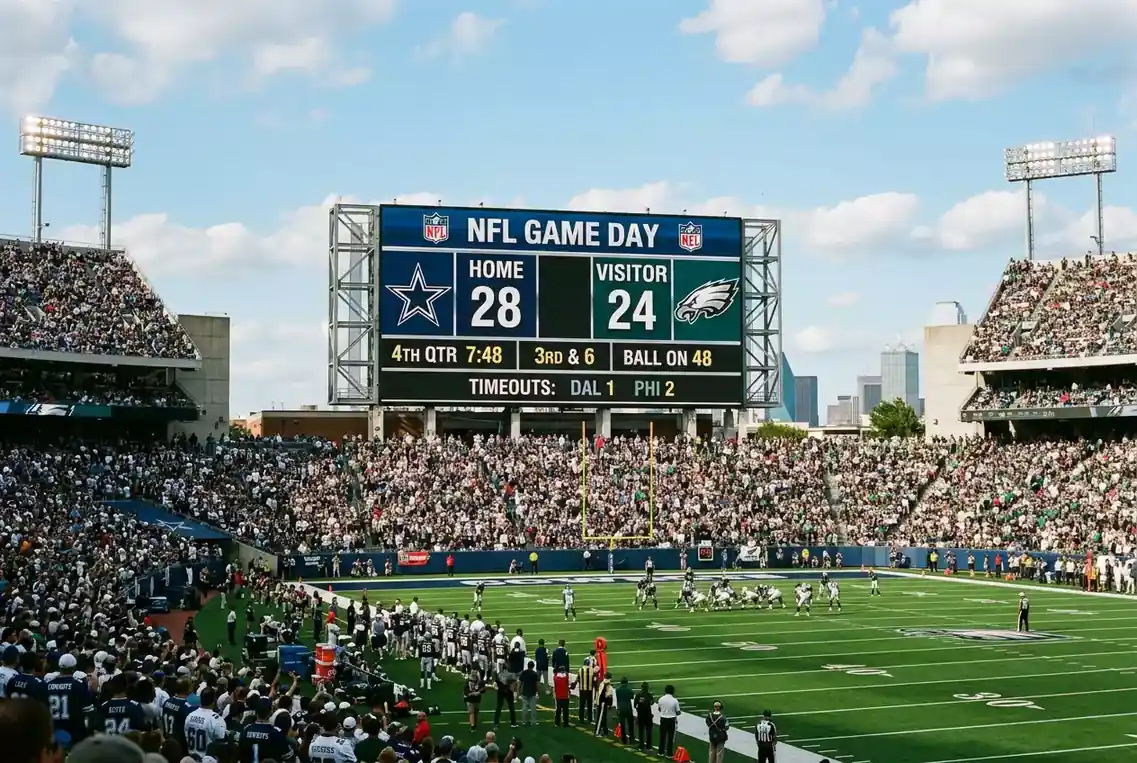
Strategies for Betting NFL Game Totals
British and Irish punters betting on the NFL grew by 65% year on year during the 2024/25 season, and totals markets are absorbing a growing share of that volume. I have a theory about why: totals let you bet on the nature of a game rather than its winner, which is a more natural analytical angle for anyone who has ever said “this is going to be a shootout” or “the defences will dominate” while watching from the sofa. You do not need to pick a side. You just need to read the game correctly.
Game Totals Explained
A game total — the “over/under”— is a line set by the bookmaker representing the combined final score of both teams. If the total is set at 47.5 and you bet the over, you need 48 or more combined points. Bet the under, and you need 47 or fewer. The .5 eliminates the possibility of a push, so every bet settles as a win or a loss.
UK sportsbooks price both sides of the total at similar odds, typically around 1.90 to 1.93, with the slight variation reflecting the bookmaker’s view on which side carries more risk. The margin is usually tighter on totals than on some prop markets, which makes totals one of the more efficient NFL betting markets — and therefore one where your research needs to be sharper to find an edge.
I approach game totals by building a simple expected-points model. Take each team’s average points scored and allowed over their last six games, adjust for opponent strength, and average the result. If my model spits out 45.2 and the line is 48.5, the under has value. If my model says 51.0 and the line is 47.5, the over is the play. The model is imperfect — every model is — but it forces a structured decision rather than a gut feeling.
Team Totals
Favourites covered the spread only 47.8% of the time in the 2025 NFL season, which is one reason I increasingly prefer team totals to game totals. A team total is the over/under on one team’s individual score, independent of what the opponent does. If a team total is set at 24.5, you are betting on whether that team scores 25 or more, regardless of the final game score.
Team totals strip out a layer of noise. When you bet a game total, you need both offences and both defences to cooperate with your thesis. When you bet a team total, you only need one offence and one defence to align. That is half the variables, half the ways to be wrong.
I find team totals especially useful in games with a large spread. If a 10-point favourite has a team total of 28.5, the implied game script suggests they will score comfortably. But if their defence is also elite, the game total might be low (say, 41.5), and the opponent’s team total might sit at just 13.0. Betting the favourite’s team total over can be a way to express confidence in their offence without worrying about whether the underdog’s garbage-time scoring inflates the game total past the number.
One overlooked advantage of team totals: they settle independently of the opponent’s performance. If you back a team total over 24.5 and the game finishes 31-3, you win cleanly. The blowout nature of the game — which might have killed a standard game total under bet as the opponent fails to contribute — is irrelevant to your position. This structural independence makes team totals the more precise tool when your conviction is about one team’s scoring capability rather than the overall game environment.
Factors Affecting Totals
Three variables move NFL totals more than anything else: pace, weather, and injury. Pace is measured by plays per game — fast-paced offences run more plays, creating more scoring opportunities. Two up-tempo teams meeting in a dome environment produce the highest-scoring games in the league. Two methodical, run-heavy teams meeting in December produce the lowest.
Weather deserves its own mention because its impact on totals is direct and measurable. Wind above 15 mph suppresses passing efficiency, which lowers scoring. Rain makes the ball slippery, increasing fumble risk and reducing deep-passing accuracy. Snow compresses scoring further. Cold alone has a smaller effect than wind or precipitation, but extreme cold (below -10C) does reduce kicking accuracy, which can affect field goal-dependent scoring in close games.
Injuries to quarterbacks are the single biggest line-mover for totals. A backup quarterback entering the game drops the expected team total by 3-7 points depending on the quality gap. If a starting quarterback is ruled out on Friday, you will see the game total adjust sharply before the casual betting public arrives on Saturday. Being first to react to injury news is a genuine edge in totals markets.
One factor that casual bettors underweight: rest and scheduling. Teams coming off a bye week average slightly higher scoring outputs than teams on standard rest, and Thursday Night Football games — played on short rest — historically produce lower totals than Sunday games. These patterns do not guarantee outcomes, but they shift probabilities at the margins, which is exactly where totals bets are won and lost.
Key Numbers for Totals
Just as 3 and 7 are the key numbers for NFL spreads, totals have their own set of high-frequency landing spots. Games most commonly produce combined scores in the 37-51 range, with 44 and 47 appearing slightly more often than adjacent numbers. This matters when you are deciding whether to bet a total of 44.5 or wait for line movement to push it to 45.5 — that single point crosses a high-frequency number and changes the probability distribution of your bet.
The concept of “buying points” on totals — paying a higher price to move the line by half a point — is worth the cost only when the adjustment crosses one of these key numbers. Moving from 44.5 to 44.0 crosses a landing spot and meaningfully changes your win probability. Moving from 46.5 to 46.0 is less impactful because 46 is not a high-frequency result. Knowing where the key numbers sit lets you make smarter decisions about when to pay for a better number and when the extra cost is wasted.
What factors move NFL over/under lines before kickoff?
The three primary movers are weather forecasts (especially wind and precipitation), quarterback injury reports, and sharp betting action. Wind above 15 mph and starting quarterback absences both push totals downward. Sharp bettors who move large amounts early in the week can shift the line by 1-2 points before casual money arrives on the weekend.
Are NFL totals easier to predict than point spreads?
Not inherently easier, but they involve fewer variables. Totals depend primarily on offensive pace, defensive efficiency, and game environment — factors that are measurable and relatively stable week to week. Spreads add the dimension of competitive margin, which is harder to predict. Many experienced bettors find totals more analytically tractable, but the market is also efficient, so edges are thin.
Prepared by the nfl Betting Fourm editorial staff.