Converting NFL Odds Formats for UK Punters
 Available in US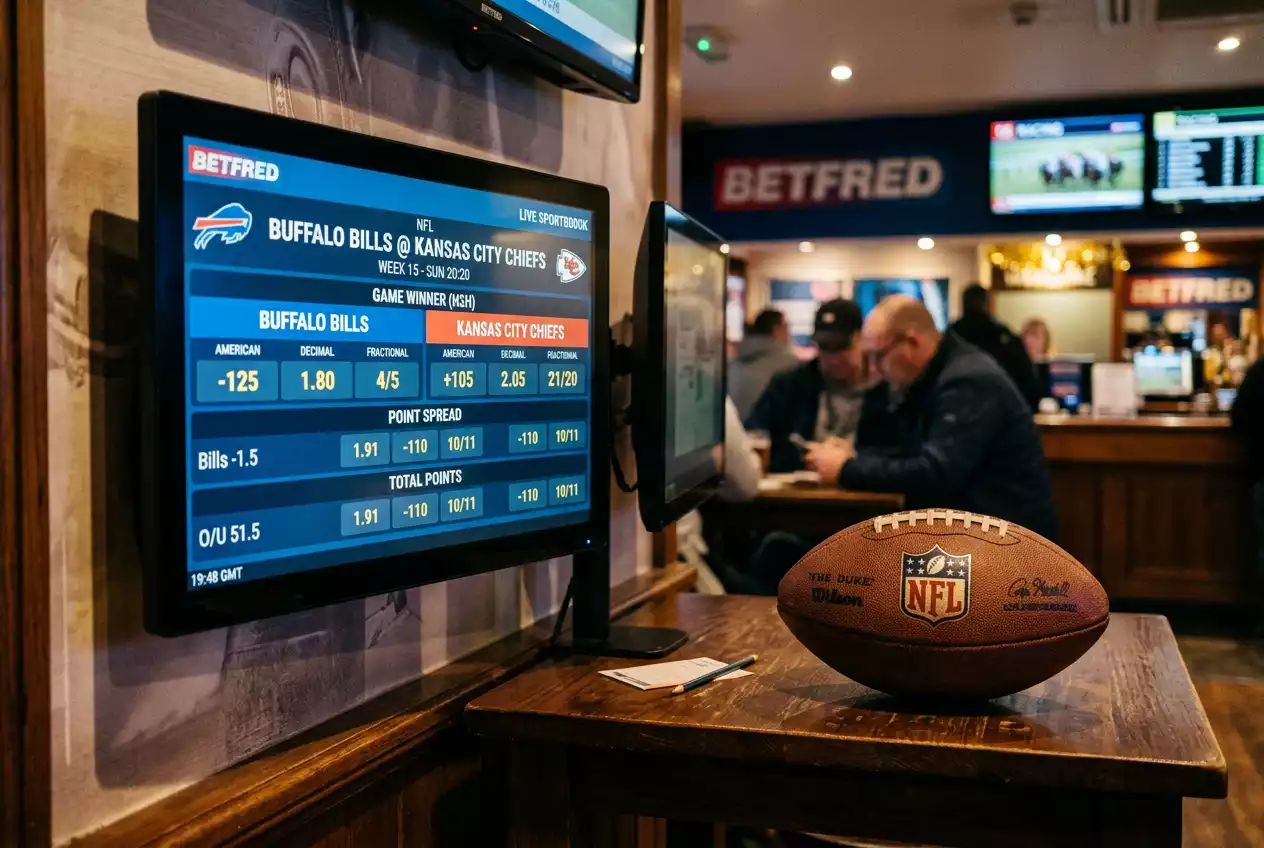
Comparing Decimal, Fractional, and American NFL Odds
About 10% of the UK population bets on sport online, and nearly all of them see odds displayed in decimal format by default. That works perfectly for Premier League football or horse racing. The moment you start researching NFL, though, you run headlong into American odds — a format that looks alien if you have spent your entire betting life working in decimals or fractions. I spent my first NFL season constantly Googling “what does minus 110 mean?” before I built the mental shortcuts that now let me convert formats on the fly. This guide gives you those shortcuts.
Decimal Odds for NFL
Decimal odds are the native language of UK sportsbooks. The number represents the total return on a one-unit stake, including the stake itself. If an NFL spread is priced at 1.91, a 10-pound bet returns 19.10 — that is 9.10 in profit plus your original 10 pounds back.
The beauty of decimal odds is that comparison is instant. A price of 2.10 is better than 2.00, and both are better than 1.90. No mental gymnastics required. For NFL markets, most spreads and totals sit in the 1.85 to 1.95 range, with the bookmaker’s margin baked into the gap between the two sides. Moneyline favourites drop below 1.50; underdogs stretch above 3.00.
Calculating your potential profit is equally straightforward: multiply your stake by the decimal odds and subtract the stake. For a 25-pound bet at 1.91: (25 x 1.91) — 25 = 22.75 profit. That simplicity is why decimal odds have become the global standard in online betting, and it is the format I recommend every UK NFL bettor uses as their default.
Fractional Odds for NFL
Football — the one that generates over a billion pounds in GGY annually in the UK — still uses fractional odds in many traditional settings. Horse racing clings to them. Some UK sportsbooks display NFL prices in fractional format by default or as an alternative view, and you need to know how to read them.
Fractional odds express the profit relative to the stake. Odds of 5/1 mean you win five pounds for every one pound staked, plus your stake back. Odds of 4/5 mean you win four pounds for every five pounds staked. The first number is profit; the second is stake.
Converting fractional to decimal: divide the fraction and add 1. So 5/1 becomes (5 / 1) + 1 = 6.00. And 4/5 becomes (4 / 5) + 1 = 1.80. For NFL spreads, the common fractional equivalent of 1.91 is 10/11 — ten pounds profit for every eleven staked.
Fractions become awkward with NFL because the numbers are not round. A moneyline price of 2.35 in decimal translates to 27/20 in fractional, which is not intuitive for quick mental calculations. This is precisely why most UK-based NFL bettors switch to decimal and never look back. Every sportsbook lets you toggle between formats in your account settings — change it once and forget about fractions entirely unless you are chatting with someone at the races.
American Odds Conversion
Every piece of NFL analysis from the United States uses American odds, and if you read US-based handicapping forums, injury reports, or line-movement trackers, you need to decode them. American odds use a plus/minus system anchored around a base of 100.
Negative odds (e.g., -150) indicate the amount you must stake to win 100 units. Positive odds (e.g., +130) indicate the profit you receive for a 100-unit stake. The mental model: minus signs are favourites, plus signs are underdogs. The bigger the minus number, the heavier the favourite. The bigger the plus number, the longer the underdog.
Converting to decimal: for negative American odds, divide 100 by the absolute value and add 1. So -150 becomes (100 / 150) + 1 = 1.667. For positive American odds, divide by 100 and add 1. So +130 becomes (130 / 100) + 1 = 2.30.
The reverse: to convert decimal to American, if the decimal is 2.00 or above, multiply (decimal — 1) by 100 to get the positive figure. So 2.30 becomes (2.30 — 1) x 100 = +130. If the decimal is below 2.00, divide -100 by (decimal — 1). So 1.667 becomes -100 / (1.667 — 1) = -150.
I keep a small conversion table bookmarked on my phone for the most common NFL prices: -110 = 1.91, -200 = 1.50, +150 = 2.50, +200 = 3.00, +300 = 4.00. After a few weeks of regular use, the conversions become second nature and you stop needing the table entirely.
Implied Probability
The single most useful thing any odds format tells you is the implied probability of the outcome. This is the bookmaker’s estimate of how likely something is to happen, embedded in the price, and it is the number you should be comparing against your own assessment every time you consider a bet.
The formula in decimal: implied probability = 1 / decimal odds. A price of 1.91 implies a probability of 52.4%. A price of 3.00 implies 33.3%. A price of 1.50 implies 66.7%. If your analysis says a team has a 58% chance of covering the spread and the implied probability from the odds is 52.4%, the gap between your number and the market’s number is your edge.
The overround is the sum of implied probabilities for all outcomes in a market. For a two-way NFL spread priced at 1.91 on both sides, the implied probabilities sum to 104.8%. That extra 4.8% is the bookmaker’s theoretical margin. On an exchange, the same market might sum to 102%, which is why exchange odds are structurally better — a point explored in detail in the spread betting guide.
Understanding implied probability transforms how you evaluate any bet. You stop asking “will this team win?” and start asking “is this team more likely to win than the price implies?” That shift in framing is, in my experience, the single biggest leap a UK punter can make when moving from casual to disciplined NFL betting.
How do I convert American NFL odds to decimal format?
For negative American odds like -150, divide 100 by the absolute value and add 1: (100 / 150) + 1 = 1.667. For positive American odds like +130, divide by 100 and add 1: (130 / 100) + 1 = 2.30. Common NFL benchmarks: -110 equals 1.91, +150 equals 2.50, +200 equals 3.00.
What is implied probability and how does it apply to NFL betting?
Implied probability is the likelihood of an outcome as estimated by the bookmaker’s price. Calculate it by dividing 1 by the decimal odds — a price of 1.91 implies a 52.4% chance. If your own analysis estimates a higher probability than the market implies, you have identified potential value. The gap between your assessment and the implied probability is the edge you are betting on.
Written by the editors at nfl Betting Fourm.